Release Highlights for Sites
Release Date: August 7, 2026
The 26R2.0 release of most Veeva products for sites is August 7, 2026. Summaries of the major highlights are below for site-facing products as they become available (release timelines vary by product). To view the full release notes for a product, follow the link in the product's section.
Veeva eCOA
Select here to read a full list of what's new in Veeva eCOA this release.
Support for Multiple Caregivers
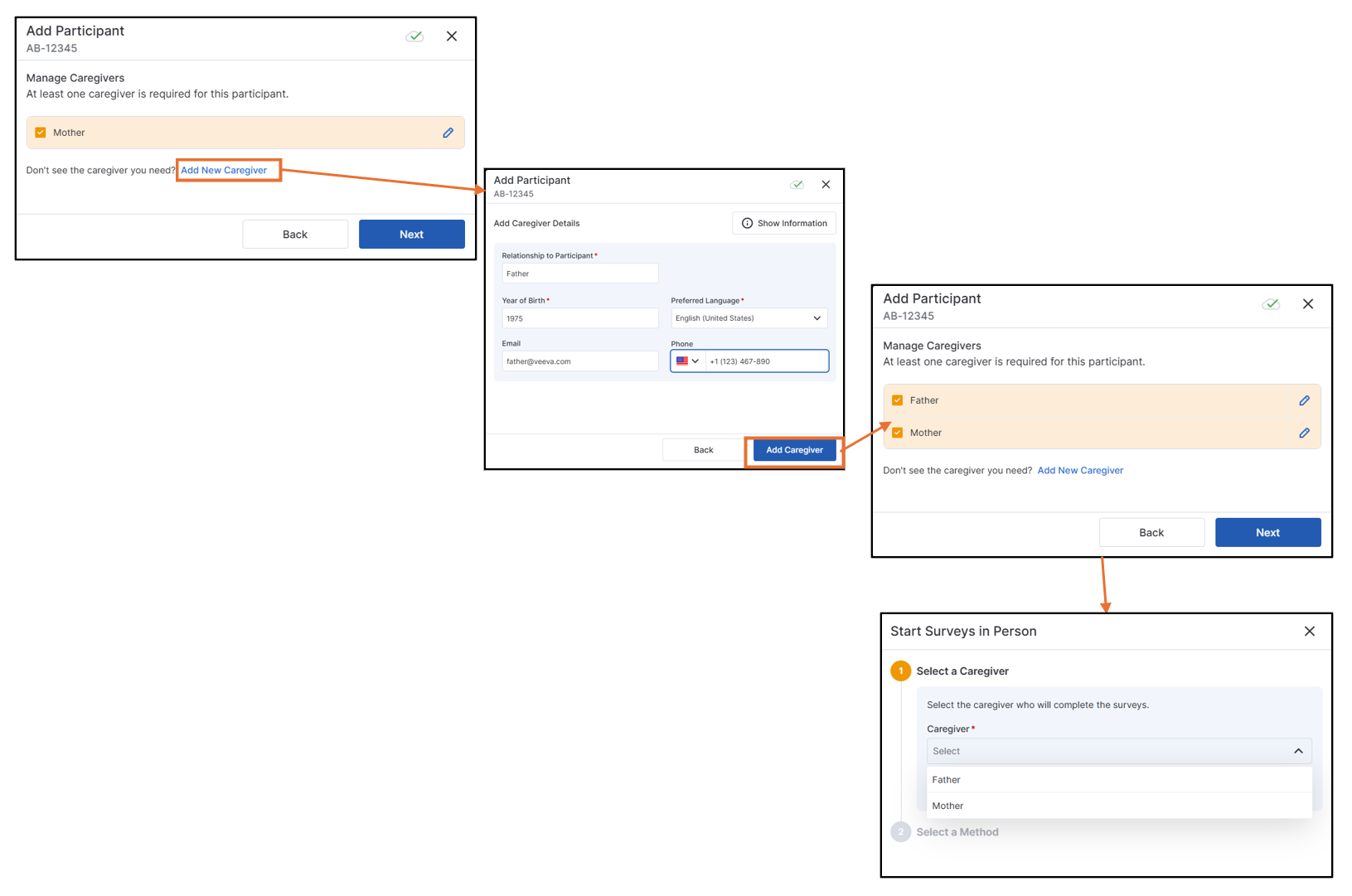
This feature enables you to assign up to five caregivers to a participant. All assigned caregivers can receive survey tasks. When starting surveys in-person, you must select which caregiver will be completing the caregiver surveys. Reports are updated to separate the Caregiver role and detailed Relationship information into different columns. When multiple caregivers are added for a participant and a caregiver starts a survey, they can claim that survey. A claimed survey cannot be answered by other caregivers, even if they are assigned to the participant.
Compliance Schedule View
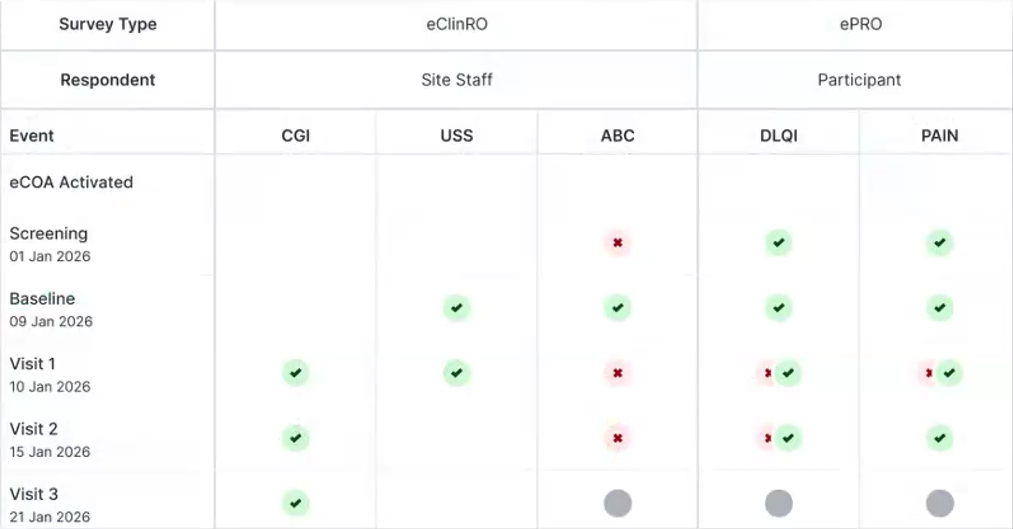
This feature enables you to view a participant's survey compliance status in the scope of the study's schedule of assessments. You can more quickly identify completed or missed surveys at specific protocol events.
Veeva EDC
Select here to read a full list of what's new in Veeva EDC this release.
Dynamic Site Enrollment Quota
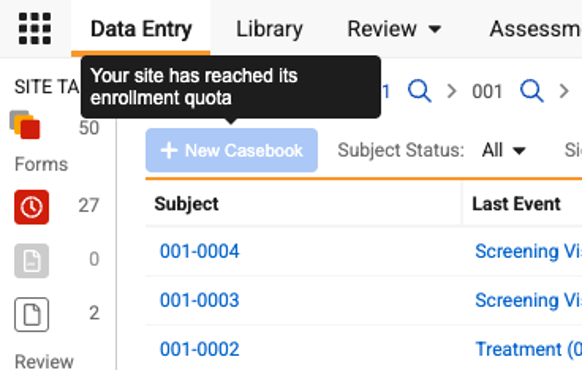
Study sponsors can now optionally set enrollment ceilings for individual sites, based on subject status (for example, total subjects not counting screen failures or withdrawn subjects). Once a site reaches its designated limit, the +New Casebook button is automatically disabled and a pop-up message appears when hovering over it to explain that the site has reached its quota.
Veeva RTSM
RTSM Temperature Excursion Tracking & Automation
Shipment Receipt & Multi-Excursion Logging
- Mandatory Data Capture: System enforces mandatory temperature data entry during the Shipment Receipt process for temperature-controlled study drugs before receipt can be completed.
- Multi-Instance Support: Users can log multiple discrete excursion events for a single shipment, capturing specific temperature, time/duration, and reason for each individual instance.
- Kit-Level Traceability: System automatically generates a discrete excursion record for every single kit within an affected shipment.
Automated Threshold Evaluation & Status Updates
- Initial Receipt Logic: System automatically assigns the appropriate kit status upon receipt by evaluating recorded temperatures against pre-defined excursion thresholds.
- Cumulative Time Tracking: System aggregates the total duration of all "Out-of-Range" excursions for a specific kit to determine if its cumulative time limit has been breached.
- Immediate Quarantine: Kits are automatically updated from a configurable ready-for-use status to a configurable restricted-use status immediately upon exceeding their cumulative time limit.
System Notifications
- Automated Alerting: System supports real-time notification generation whenever a temperature deviation is reported.
Navigation and Menu Enhancement
We have completely redesigned our system menus to provide a cleaner, more intuitive user experience. As our platform has grown, our old menus became crowded and lacked clear categorization. This update simplifies your workflow by making options easier to find.
What is New?
- Streamlined Navigation: We reduced menu clutter by grouping related features together.
- Intuitive Labeling: Menu names now clearly reflect the tools and actions found inside them.
- Improved Discoverability: Hidden sub-options are now organized under logical parent categories.
Veeva Site Connect
Select here to read a full list of what's new in Veeva Site Connect this release.
Study Plan
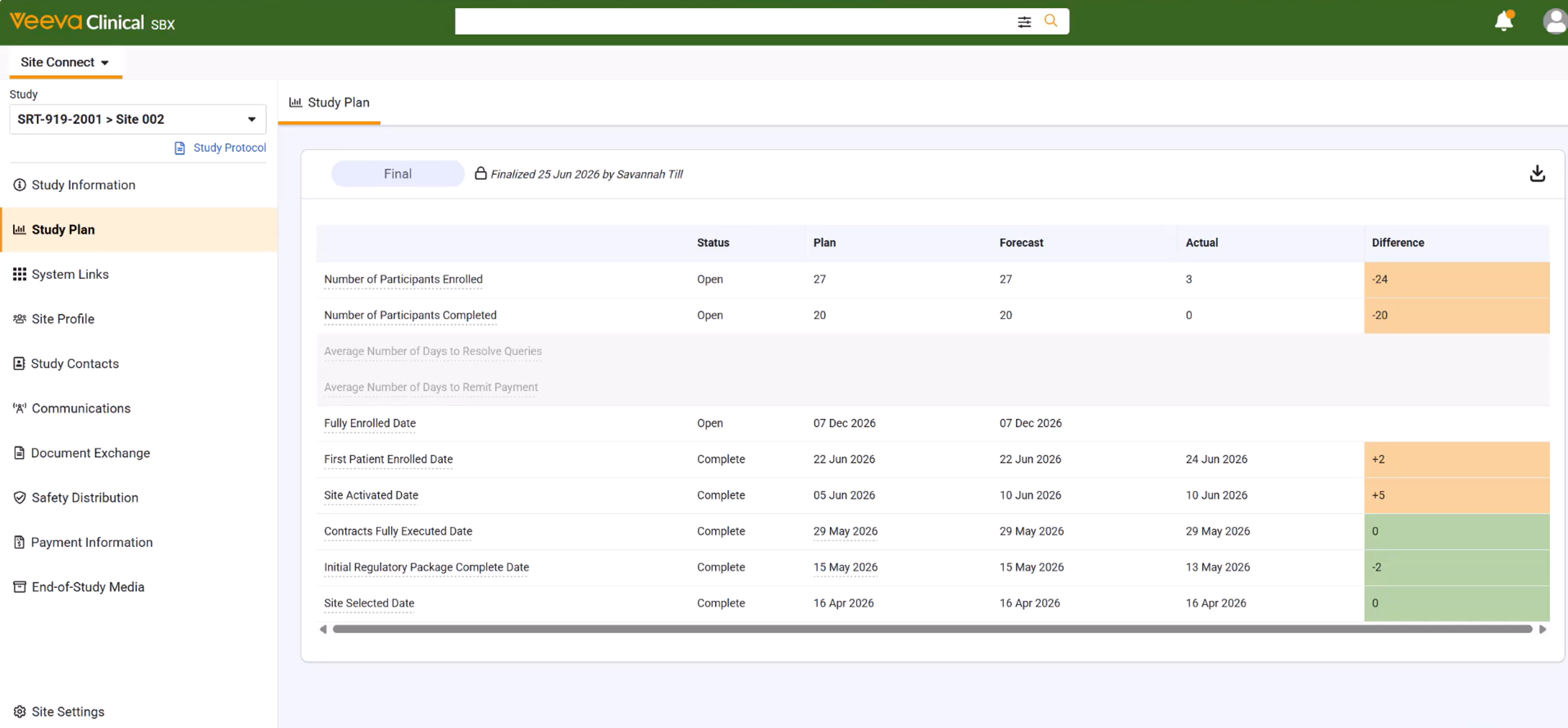
Study Plan introduces a new application section within Site Connect that enables Sponsors/CROs and study sites to collaboratively develop, agree upon, and measure against a plan for a study. The plan will consist of standard metrics (e.g., Participants Enrolled) and milestones (e.g., First Patient Enrolled Date). By utilizing a shared tracking space directly in the interface, both parties can work from the same definitions to align on expectations, sites can gain clear visibility into operational benchmarks, and teams can ultimately accelerate trial execution.
Give Study Plan a try using this interactive demonstration.
Daily Document Exchange Emails
To streamline communications and reduce fragmented document exchange notifications, sites now receive one daily document exchange email. With this update, Site Connect consolidates document exchanges—whether sent manually, through packages, or via auto-exchange—into a single, comprehensive daily digest per sponsor. This ensures that sites receive a predictable, organized summary of the day’s document exchange on a sponsor by sponsor basis. Included in this summary is also document recall notifications.
Optional Safety Distribution Acknowledgment
Safety documents that do not require formal acknowledgement from a site can now be noted as such, ensuring that the document does not prompt a task for the site. The documents are still visible within the All Documents tab of the Safety Distribution section and in the All and Received tables of the Document Exchange section. In Safety Distribution, the Acknowledged By and Acknowledged Date columns will display Acknowledgement Waived by Sponsor/CRO.
Veeva SiteVault
Select here to read a full list of what's new in Veeva SiteVault this release.
Digital Delegation General Enhancements
This release includes several functional updates to the Digital Delegation Log (DDL) to improve workflow efficiency, user interface navigation, and data validation.
- Study Closure Action: A new study closure action from Study > View Study Details ends all active delegations, generates a new DOA document version, and routes it for PI Approval. The workflow stops short of full DDL disablement to ensure site staff can make any necessary final manual adjustments.
- Fast Fill Tool Available on Start/End Dates: While working in the Delegations Editor, SiteVault’s Fast Fill tool is available to apply the same date to all staff listed in the Start Date or End Date columns.
- Manage Study Responsibilities: Users can now create and edit Study Responsibility names directly inside the Delegations Editor.
- Assignment Status Management: The Assignment Status can now be updated directly via Administration > Staff > Select Staff > Study Assignments for studies enabled with Digital Delegation.
- Automated Document Date: The date the Principal Investigator (PI) applies their electronic signature for approval is automatically populated as the Document Date on the Delegation of Authority (DOA) document.
- Staff Details Drawer: Selecting a name in the Delegations Editor's Study Team column opens a drawer showing assigned responsibilities, start/end dates, and delegation details. These fields are editable for authorized users.
- Date Validation Logic: For ease of use, the following validation rules have been implemented:
- Prevent delegation start and end dates from extending before or after the staff's overall Study Team Assignment Dates.
- Start dates are no longer required when assigning the Study Team on studies enabled with DDL.
- Inactive Responsibilities Filtering: Inactive responsibilities are hidden from the main view of the Delegations Editor. If an inactive responsibility was historically delegated, it remains visible within the individual staff member's detail drawer to preserve historical records.
Dynamic Delegation Acceptance Participants
The Digital Delegation Log (DDL) Send for Acceptance workflow now automatically populates the participant list with study team members who have delegation updates since the last approved version of the DDL. This eliminates the need for workflow initiators to manually select individual reviewers.
Please Note:
- Staff members who are hidden from the delegation log or removed from the study are excluded from the workflow and will not block acceptance.
- For the initial version (V1) of a log, the full study team will still default into the workflow because an approved baseline does not yet exist.
CTMS Central Activity Library
This feature introduces a centralized repository to seamlessly create, define, and manage a master list of standard study activities. These library tools streamline the workflow for adding activities to a study schedule, while allowing users to link clinical activities directly to financial data, such as Charge Codes.
CTMS PDF Invoice Generation
This update introduces automated PDF invoice generation within SiteVault. Instead of manually exporting billable items to external spreadsheets, the system now automatically generates and files finalized invoice documents directly into the study eBinder.
- Automated PDF Compilation: Moving an invoice out of Draft generates a standardized PDF invoice containing relevant study information and itemized fee tables.
- Ready to Send State: A new lifecycle state, Ready to Send, is available immediately following the Draft state. Moving an invoice to Ready to Send finalizes the data, automatically generates the PDF, and locks the invoice record from further changes.
- On-Demand Previews: Site staff can generate a layout preview at any time while the invoice is in the Draft state. Previews are saved in the study eBinder as Draft Invoice documents.
- Version Stacking: To prevent duplicate files in the eBinder, all generated previews and finalized versions for a single invoice are automatically stacked as versions under a single document record.
- Template Fields: All sites utilize a single standardized layout. Options for site customization include:
- Site Logo: An optional image upload to display on the invoice header.
- Free-Text Comments: An optional field for adding invoice-specific notes.
Veeva AI Schedule Builder
This feature is initially available only to Enterprise Early Adopter CTMS customers.
The new Schedule Builder introduces Veeva AI capabilities to CTMS to significantly reduce study startup time. Instead of manually transcribing and building study schedules from scratch, users can now leverage Veeva AI to automatically generate an initial draft directly from a protocol document.
- Automated Draft Generation: Analyzes an uploaded protocol document's Schedule of Events to automatically extract and map key protocol data.
- Rapid Background Processing: Generates a comprehensive draft schedule behind the scenes within minutes.
- Core Element Mapping: Automatically populates visit groups, branching logic, visits (including timing and windows), activities, and links activities to the Activity Library.
- Conservative Data Extraction: The system will leave a required field blank if it cannot determine the correct information with high confidence, rather than guessing.
- Draft Status Only: The builder is designed to provide a head start, not a final product. All AI-generated schedules are created as drafts and are not ready for immediate production use.
- Mandatory Review Workflow: Human validation is required. Users must review, refine, and manually promote from Draft to Current. Common areas requiring manual adjustment include off-by-one activity assignments and complex visit windows.
- Functional Limitations: The system does not track or populate study arms, default cycle numbers, custom ad hoc visits, or whether an activity is optional or repeated.
- Document Formatting Impact: Accuracy may decrease if the protocol table is oriented incorrectly (e.g., rotated landscape pages) or if the grid is highly dense and compressed.
Veeva Study Training
Select here to read a full list of what's new in Veeva Study Training this release.
My Study Team: Individual Learner Page View
Clinical Research Associates (CRAs) and Principal Investigators (PIs) require a direct way to view detailed training history for their study staff without relying on reports (which PIs cannot access). There is now a dedicated Individual Learner Page, accessible by clicking a Learner’s (Site Staff) card on the My Study Team page, that displays comprehensive views of the Learner’s open, completed, and all Training Assignments. Those monitoring progress can now quickly determine whether a Learner is qualified to perform specific tasks or if they require prompting to complete outstanding requirements without waiting for manual reports.
VeevaID
Select here to read a full list of what's new in VeevaID this release.
VeevaID Contextual Help for Personal Detail Updates
When VeevaID users update their personal details in the My Account tab, they are now required to provide acknowledgement that the changes they are making are correct. This enhancement helps increase user awareness around potential downstream impacts of incorrect updates.
If the user is updating their email, they will acknowledge that they are providing their official business email, and it is not a shared email address. When users update their other personal details, they will acknowledge the changes, and specifically that they are providing legal name information that matches official identification documentation.
No release notes match the selected filters.